Machu Picchu can be approached by several trekking routes, but they do not all tell the same historical story. The Classic and Short Inca Trails enter through protected archaeological landscapes connected with the Inca road system. Salkantay, Lares and Huchuy Qosqo follow different mountain corridors, combining natural scenery, living Andean communities and selected archaeological sites. Choosing well means looking beyond distance and photographs to history, altitude, permits and the experience you want.
Machu Picchu and the Inca road network
The Inca state linked much of the Andes through the Qhapaq Ñan, an immense network of roads, bridges, stairways and way stations. These routes supported administration, communication, pilgrimage and military movement. The trails near Machu Picchu belonged to a wider cultural landscape in which roads connected settlements, agricultural terraces and sacred places.
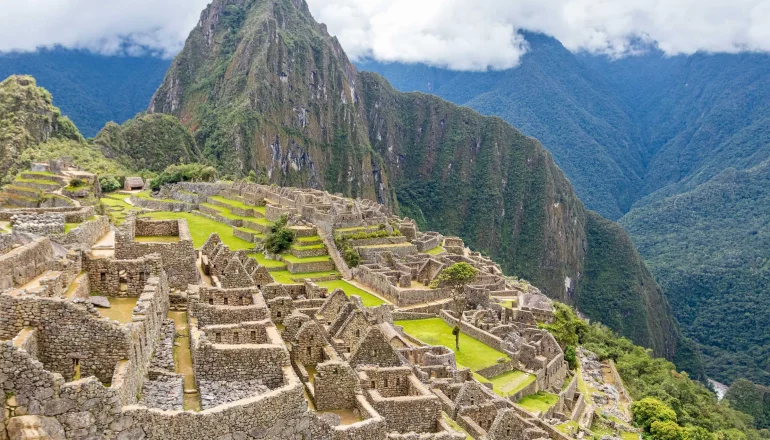
Machu Picchu was built in the 15th century, probably during the reign of Pachacuti. It combined elite residence, ceremony, agriculture and sophisticated water management. Local people knew the site before Hiram Bingham arrived in 1911; describing it simply as a “lost city discovered by Bingham” erases that local history.
Classic Inca Trail: archaeology along the route
The four-day Classic Inca Trail covers roughly 42 kilometres and reaches about 4,215 metres at Warmiwañusca, commonly called Dead Woman’s Pass. Its importance lies not only in the final view of Machu Picchu. Trekkers pass sites such as Runkurakay, Sayacmarca, Phuyupatamarca and Wiñay Wayna, observing how Inca builders adapted roads, terraces, water channels and ceremonial spaces to steep terrain.
The route ends at Inti Punku, the Sun Gate, creating a historically meaningful pedestrian arrival. Permits are limited and tied to authorised operators, guides and fixed dates. The trail normally closes during February for conservation work. Our Classic Inca Trail to Machu Picchu is best for travellers who want the strongest combination of archaeology and trekking.
Short Inca Trail: a concentrated historical route
The Short Inca Trail joins the protected route at kilometre 104. It climbs through cloud forest to Chachabamba and Wiñay Wayna before approaching Machu Picchu through the Sun Gate. Although far shorter than the classic trek, it still gives visitors a direct encounter with Inca engineering and archaeological sites.
Choose the Short Inca Trail with hotel for a more comfortable overnight stay, or the Short Inca Trail with camping for an outdoor experience. Both options still require controlled entry and advance confirmation.
Huchuy Qosqo: a quieter archaeological journey
Huchuy Qosqo overlooks the Sacred Valley and preserves terraces, water channels, stonework and adobe structures. Chroniclers associated the estate with the Inca ruler Viracocha, although interpretations of its precise role vary. Approaching on foot gives a clearer sense of how highland settlements related to agricultural land and routes through the mountains.
The Huchuy Qosqo Trek to Machu Picchu suits historically curious travellers seeking a less crowded site. It should not be described as an alternative section of the official Inca Trail; it is a distinct route with its own history.
Salkantay: sacred mountain and ecological change
Salkantay is an apu, a powerful mountain within Andean understandings of a living sacred landscape. The trek crosses a high pass of approximately 4,630 metres before descending toward warmer cloud forest. Its appeal is the dramatic transition between ecological zones rather than a continuous chain of Inca monuments.
Marketing sometimes calls Salkantay an “ancient Inca trail”, but the evidence is more nuanced: Andean people have used mountain corridors for generations, yet the modern trekking itinerary is not equivalent to the protected Classic Inca Trail. Choose the Salkantay Trek to Machu Picchu for high-mountain scenery, physical challenge and landscape history.
Lares: living Andean culture
The Lares region is known for high-altitude communities, pastoral life and textile traditions. Routes vary between operators, so villages, passes and accommodation must be checked for the chosen departure. Cultural encounters should never be treated as staged attractions: respectful visits, fair purchasing and the guidance of local partners matter.
The Lares Trek to Machu Picchu is the strongest choice for travellers who value community context and a quieter highland route. It usually connects with rail transport for the final journey to Machu Picchu rather than entering the sanctuary through the Sun Gate.
Which Machu Picchu trek should you choose?
- Classic Inca Trail: best for extensive archaeology and the iconic Sun Gate arrival.
- Short Inca Trail: best for limited time, less camping and direct access to Inca sites.
- Huchuy Qosqo: best for a quieter archaeological site and Sacred Valley perspectives.
- Salkantay: best for dramatic mountain scenery, ecological variety and a strenuous challenge.
- Lares: best for living Andean culture and less-travelled highland routes.
Plan for altitude, permits and responsible travel
Difficulty depends on maximum altitude, sleeping elevation, daily ascent, weather and personal acclimatisation—not distance alone. Read our altitude sickness guide and allow time in Cusco or the Sacred Valley before a high trek. Inca Trail permits can sell out months in advance, while alternative routes still require reliable logistics and responsible management of waste, porters and community relationships.
Alpakareisen focuses on private and small-group journeys, allowing more time for archaeological explanation and a pace suited to the travellers. Ask us to compare routes before booking if history, comfort or altitude is your main concern.