Tour Overview
Discover Peru’s “White City,” where volcanic-stone architecture, elegant courtyards and views of surrounding volcanoes create one of the country’s most distinctive urban landscapes.
Historical and Cultural Background
Arequipa grew as an important colonial city after its Spanish foundation in 1540, while the wider valley has a much longer pre-Hispanic history. Many historic buildings were constructed from pale sillar, a volcanic stone that gives the centre its characteristic appearance. Indigenous and European techniques and decorative traditions came together in the regional mestizo baroque style. The historic centre is recognised by UNESCO for this architectural heritage.
Why Visit?
- Walk through a UNESCO-listed historic centre.
- See architecture carved from volcanic sillar.
- Explore monasteries, churches and traditional neighbourhoods.
- Understand Arequipa’s identity before travelling to Colca Canyon.
-
2,335 m
In this tour through the city of Arequipa you can visit churches and convents, the countryside of Arequipa can visit the typical Arequipa in their daily activities in comfortable vehicles fully equipped, always accompanied by a bilingual guide on board explaining the tourist places to visit.
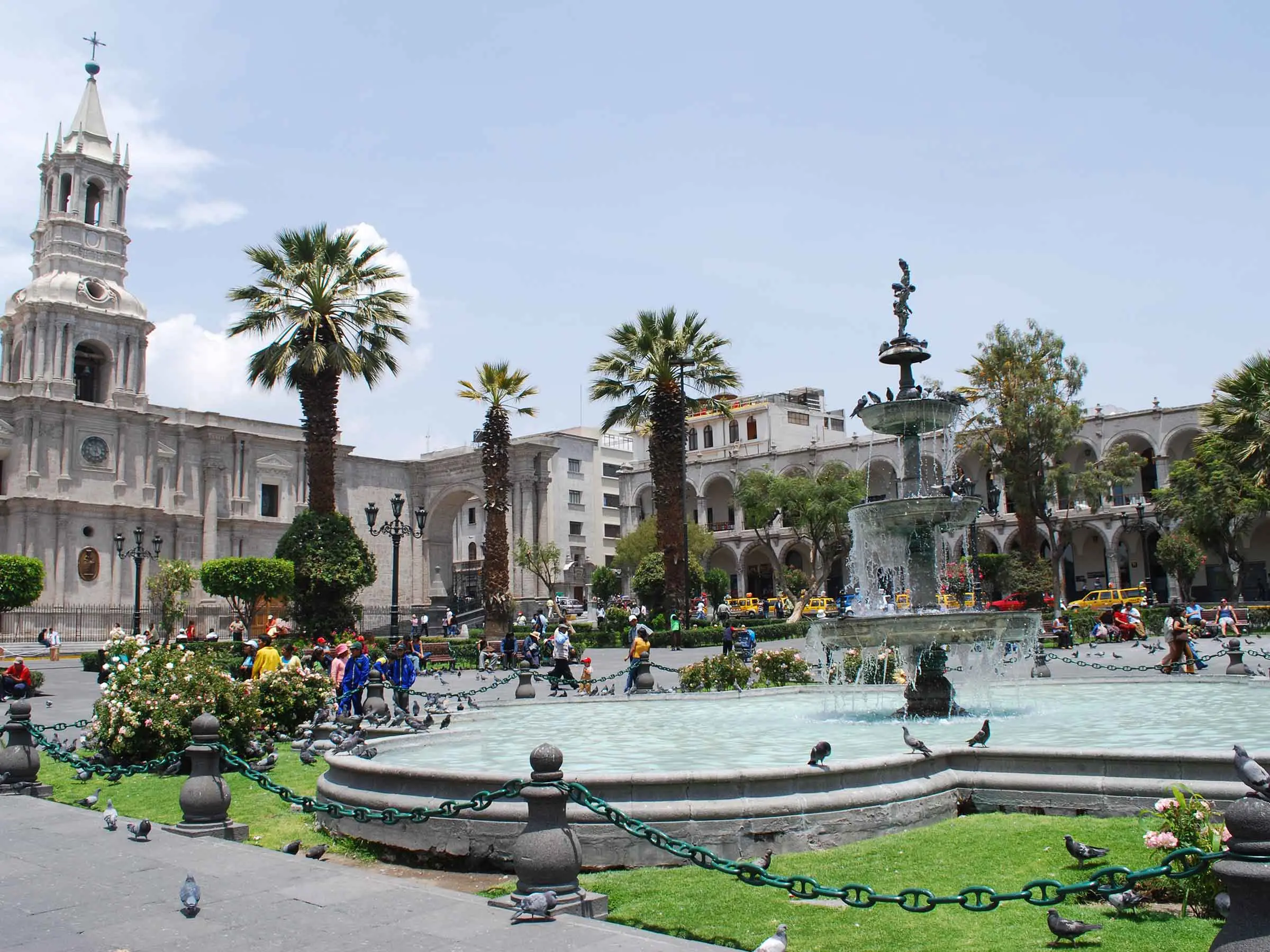
The city of Arequipa, also known as the White City, is the second most important city in Peru after Lima, the capital. Arequipa is a beautiful city that was founded by the Spaniards in 1540 in a place especially chosen for its natural beauty and cozy climate.
The Monastery of Santa Catalina de Siena, or Convent of Santa Catalina, is a religious tourist complex located in the historic center of Arequipa, department of Arequipa, Peru.
It was built as a citadel gradually, in the four plots that acquired the Cabildo de Justicia y Regimiento de Arequipa in 1568 for a monastery of “Nuns” that was to be called Nuestra Señora de la Gracia. The monastery of Santa Catalina is a sample of four centuries of Arequipa architecture.
In this monastery entered the women who so wished, although in the founding document they indicated that they must be Spanish women. They had to give a dowry of one thousand pesos of tested and marked silver and one hundred pesos for food. In the mid-18th century the population consisted of fifty-seven nuns with black veils, eighteen nuns with white veils, fifty-one donated nuns and two hundred maidens and lay maids.
AREQUIPA CATHEDRAL
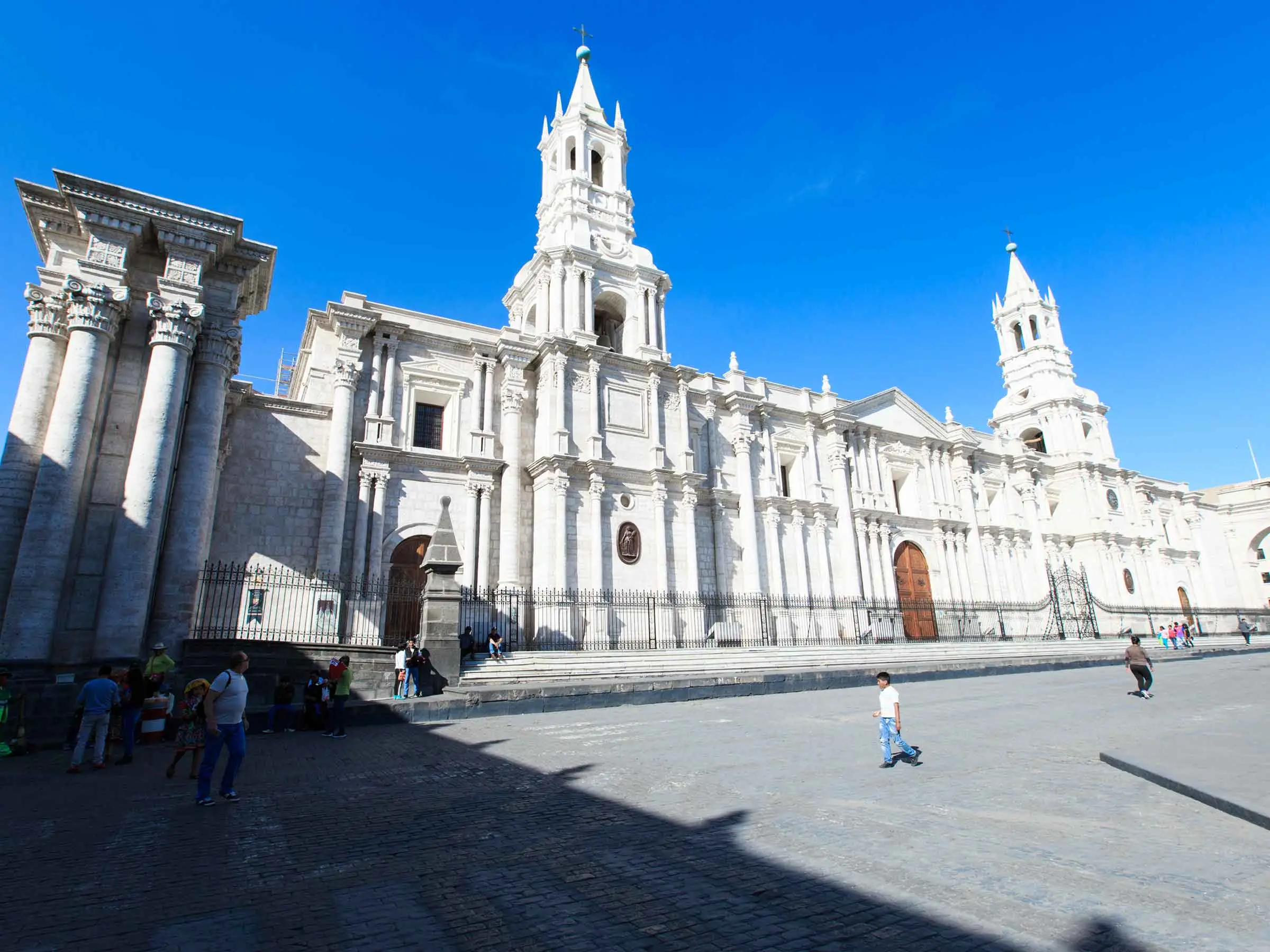
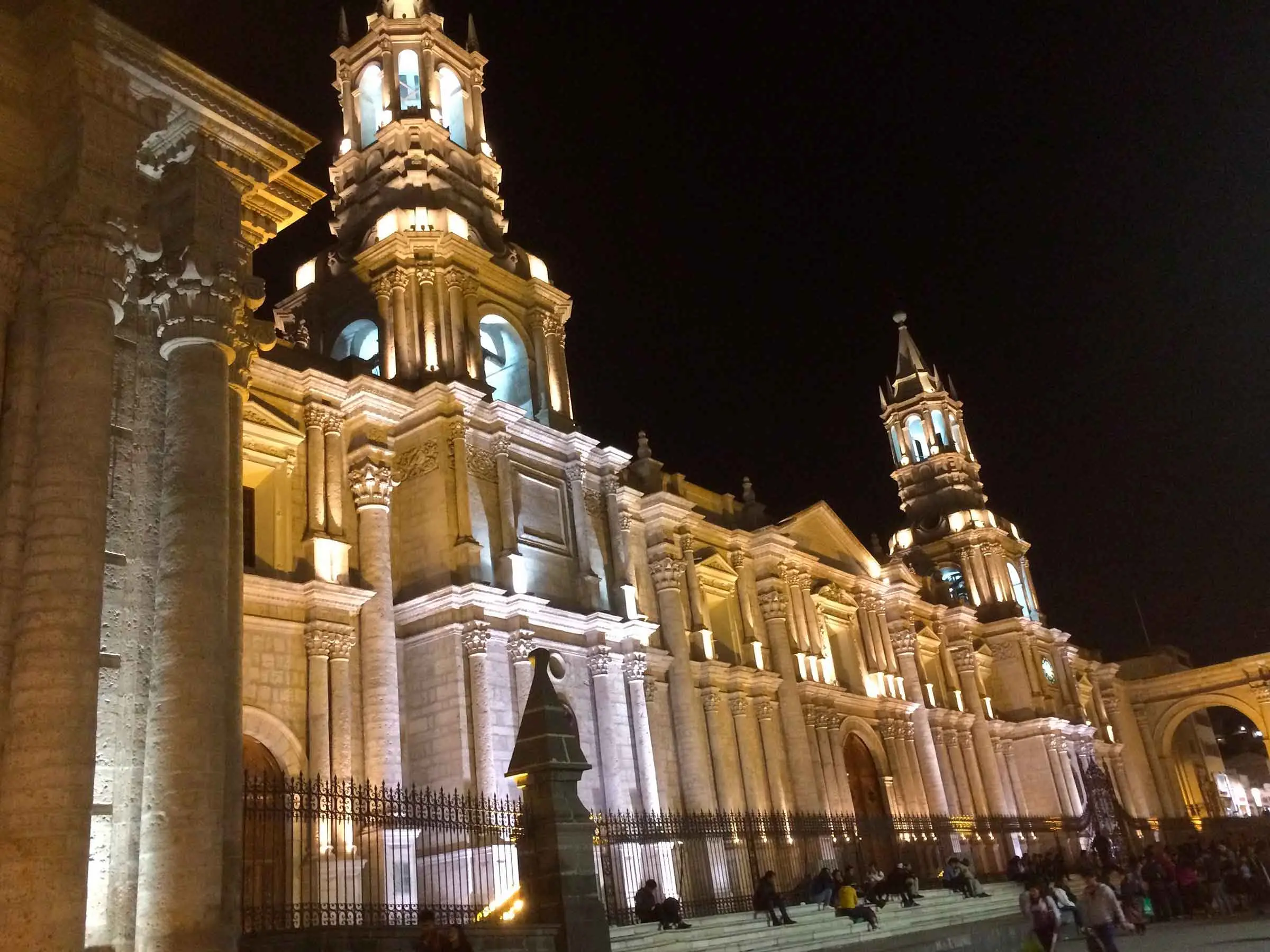
The Cathedral of Arequipa is considered one of the first religious monuments of the XVII century in the city. Built in sillar (stone of volcanic origin), with brick vaults, is the main sanctuary of the city that occupies the entire north side of the Plaza de Armas. Built entirely in ashlar, it has a neo-Renaissance style with a certain Gothic influence. Its façade consists of seventy columns with Corinthian capitals, three façades and two large side arches. It is crowned by two high Renaissance and stylized towers. Inside is the main altar, made of Carrara marble.
MUSEUM OF ANDEAN SANCTUARIES
The Museum “Andean Sanctuaries” – UCSM, was created by means of Resolution Nº 3966-R-97 of December 5, 1996, as a result of the important archaeological investigations carried out by the Project: Sanctuaries of Height of the Andean South, directed by Doctors Johan Reinhard and José Antonio Chávez Chávez.
The Sanctuary Museum houses the Mommy Juanita and several elements, is designed to become an Institute of Scientific Research and Social Projection. It currently carries out the functions of programming, promotion, development, evaluation, and dissemination of scientific research.
In the administrative organization, it reports directly to the Rectorate.
MOMIA JUANITA
The Momia Juanita, or Ampato’s maiden, or the ice lady, are the names given to the frozen body of a 14-year-old girl, who died between 1450 and 1530 found in the snowy Ampato, in southern Peru, in 1995.
It is believed to have been part of a Capac Cocha ceremony, a frequent human offering in the Inca Empire, and possibly died during the reign of Inca Sapa Pachacutec Inca Yupanqui.
During an expedition to Monte Ampato in 1995, mountain archaeologist Johan Reinhard and mountaineer Miguel Zarate saw something shimmering in the snow-covered crater in the distance and descended into the ravine in search of a bundle. They lifted it with care, and with astonishment they saw that it was the body of a young woman, excellently preserved. In addition, in the vicinity were found several villas, gold statuettes and spondyllus, several types of plants, including corn and several legumes. Days later, the remains were taken to Arequipa and initially stored in a refrigerator and are conserved in the Museum of Andean Sanctuaries of Arequipa.
Highlights
- AREQUIPA CATHEDRAL
- MUSEUM OF ANDEAN SANCTUARIES
- MOMIA JUANITA